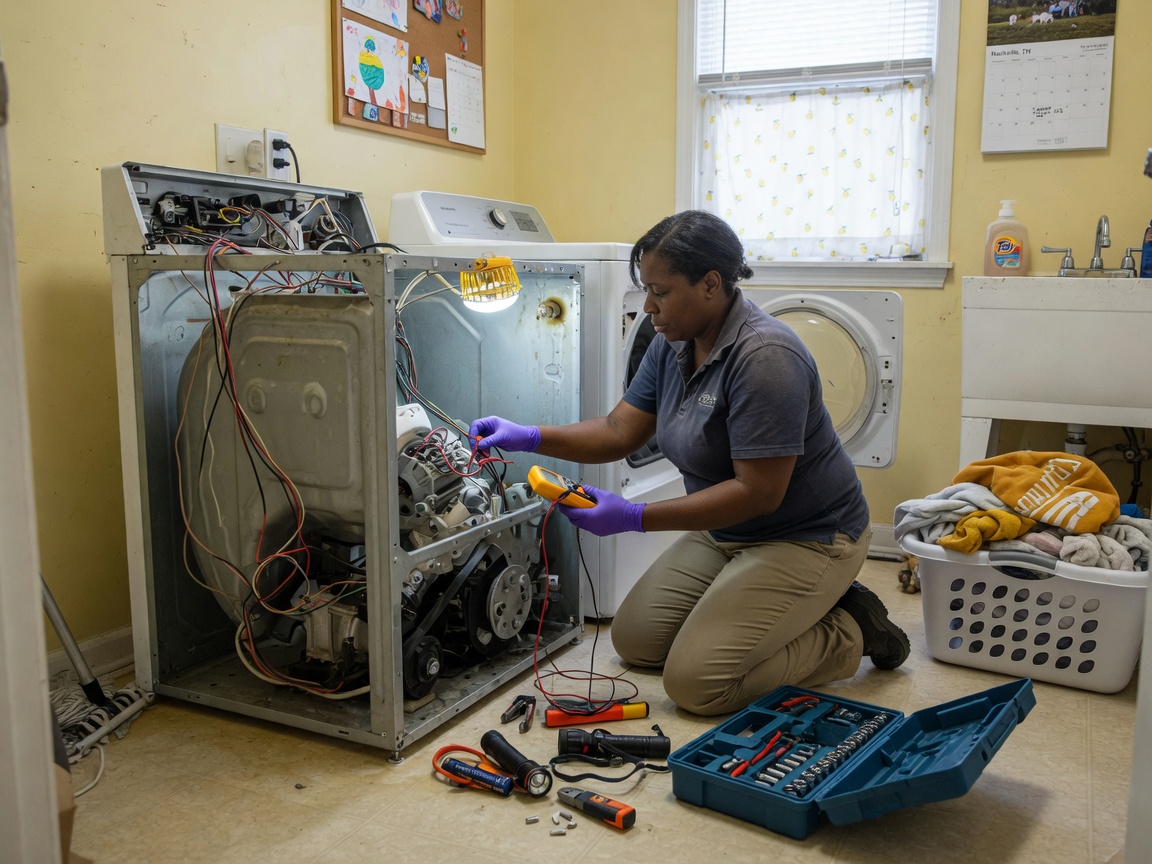
A washer that won't drain, stops mid-cycle, or is leaking from the bottom covers most of what we see on washer repair calls in Nashville. Loud grinding during spin, a washer that won't spin, a machine that fills but never agitates, or a door that won't lock are also worth noting before you call (615) 412-2497.
Washer Not Draining or Not Emptying
A washer not draining or not emptying the tub usually comes down to a clogged or failed drain pump, a kinked or blocked drain hose, or a failed lid switch or door lock that keeps the control board from continuing the cycle. Check the drain hose for a kink or clog first. If it still won't drain, the pump or switch likely needs a look, which is one of the most common washing machine repair calls we get.
Washing Machine Leaking From the Bottom
A washing machine leaking from the bottom is often a failed door boot seal on a front-load machine, a loose or cracked drain hose connection, or a worn pump seal. A machine that fills slowly or not at all usually points to a clogged or failed water inlet valve, sometimes with scale built up on the inlet screen.
Washer Stops Mid-Cycle
When a washer stops mid-cycle, a failed lid switch or door lock, a clogged drain pump, or a control board fault are the usual suspects. If it stops with water still in the drum, check the drain hose first. A machine that fills and drains but never washes or spins is covered in the next sections.
Before assuming a part has failed, check that the machine is plugged in and the breaker hasn't tripped, confirm the water supply valves behind the washer are fully open, and make sure the door or lid is closing all the way and latching.
Stop and call for help once you've ruled out a tripped breaker, closed water valves, and an obvious drain hose kink and the washer still won't fill, drain, or spin. A machine that smells like it's burning, sparks, or trips the breaker repeatedly should be unplugged and left alone until it's checked. Call (615) 412-2497 if that describes what you're seeing.
Whether it makes sense to repair a washer or replace it usually comes down to how many components have failed at once and the age of the machine, whether it's a standard top-load model, a front-loader, or a Whirlpool Cabrio washer. A single failed valve, pump, or latch is often a straightforward fix; a machine with several worn parts or a failed transmission is a bigger call to weigh. We serve homes across Nashville and nearby towns including Brentwood and Franklin, and also handle dryer repair if the same laundry pair needs a look.
Washer Not Spinning or Won't Agitate
The washer fills, runs, maybe drains, and the clothes come out soaking wet. Or it fills and drains but never washes the load. Either way the drum isn't doing its job, and the cause depends on the type of machine.
On any washer, the lid or door comes first. A lid switch or door lock that isn't engaging tells the control board it isn't safe to spin, so the motor never gets the signal. Next is the drive: a worn drive belt or a failed motor coupler lets the motor run while the drum stays still. On machines with a shift actuator, a failed one can leave the drum stuck between fill, wash, and spin. On top-loaders that fill but won't agitate, worn agitator dogs or a failing transmission are the usual finds. We see this on every brand, including Samsung and LG front-loaders.
The safe checks: make sure the lid or door closes all the way and latches, take out part of the load if the drum is packed or lopsided, and look for standing water, since many washers won't spin until the tub drains. Run a drain and spin cycle on its own to see what it does.
Stop and call if you hear grinding or banging, smell something burning, find a belt or rubber shavings, or the breaker trips. Don't reach into a drum full of water and don't keep restarting a machine that hums but won't turn. Call (615) 412-2497 and tell us what the washer does and what it sounds like.
Washer Won't Turn On or Won't Start a Cycle
There are two different problems here. If the panel is completely dead, with no lights, no sound, and no response to the buttons, the washer isn't getting power or the control board isn't. If the lights come on but pressing Start does nothing, the machine is usually waiting on a door or lid lock that isn't reporting closed, or the board isn't acting on the command.
For a dead washer, check that the plug is fully seated, look at the breaker, and test the outlet with a lamp. Many laundry outlets are GFCI protected, so look for a tripped reset button. If the outlet is live and the panel stays dark, the control board or its power connection is the next suspect. A dead outlet or a breaker that keeps tripping is an appliance power problem worth sorting out before the washer is blamed.
For lights on but no start, close the door or lid firmly and listen for the lock to click. Check that a control lock or child lock setting isn't on. On a front-loader, a door latch or hinge that is broken or worn can stop the cycle from ever starting. Stop and call if the washer smells burning, sparks, or trips the breaker more than once. Call (615) 412-2497 and we'll help sort out which part is at fault.
Washer Shaking or Walking Across the Floor
A washer that shakes or walks across the floor is most often an unbalanced load or a machine that isn't level. If it happens with small loads too, worn suspension rods or shock absorbers are the likely cause.
The safe first check is to rebalance the load and press down on each corner of the washer to see if it rocks. Adjust the feet until it sits solid. Stop and call if the drum bangs against the cabinet or you hear grinding. If the washer also won't spin, see the not-spinning section above.
If you need to fix a washing machine that won't drain, stops mid-cycle, or is leaking from the bottom, call (615) 412-2497 to describe what you're seeing before scheduling a visit.
Technician insight
One thing that catches people out with washer repair is hard water scale building up gradually inside the water inlet valve and screen. It can slow the fill time for a long while before the valve finally sticks or stops working, and by then it looks like a sudden failure rather than a gradual one.
A common call
A common call involves a washer that fills and starts a cycle but stops partway through with water still in the tub. That pattern often points to a failed drain pump or a blocked drain hose rather than a problem with the motor or transmission.
Washer Repair Services We Offer
✓Top Load and Cabrio Washer Repair
Worn agitators, transmissions, and inlet valves are checked and tested to find which one is causing the fill, agitate, or spin problem, including the UL error codes and bearing wear common to Whirlpool Cabrio washer repair.
✓Front Load Washer Repair
Door lock assemblies, drain pumps, and drive motors are diagnosed individually because any one of them can stop a front-load cycle from completing.
✓Water Inlet Valve Service
A clogged screen or a stiff valve can slow fill times or cause overflow; we test the valve and screen before replacing parts.
✓Drain Pump Replacement
A pump that leaves standing water in the tub is tested through a full drain cycle before and after replacement to confirm the fix.
✓Control Board and Shift Actuator Repair
Board and sensor faults are isolated from the shift actuator and wiring harness before we recommend replacing either one.
✓Door Latch and Lock Assembly
A latch that won't engage keeps the cycle from starting at all; we test and replace it on both top-load and front-load models.
How it works
- 1
On-Site Diagnosis
Power, water supply, and any error codes are checked first, followed by testing of the inlet valve, drain pump, and door lock.
- 2
Component Isolation
Each part that may be causing the problem is tested and identified separately so you know what actually failed.
- 3
Part Installation and Test
Once you approve the repair, we install the part and run the washer through a complete cycle to confirm it works.
- 4
Homeowner Walkthrough
We go over what was replaced and any care steps that can help avoid the same failure again before we leave.
Pricing
What a washer repair costs depends on which part failed, whether it's a straightforward mechanical part like a valve or pump, or a control board that needs to be sourced. We explain what we found and what the repair involves before any work begins.