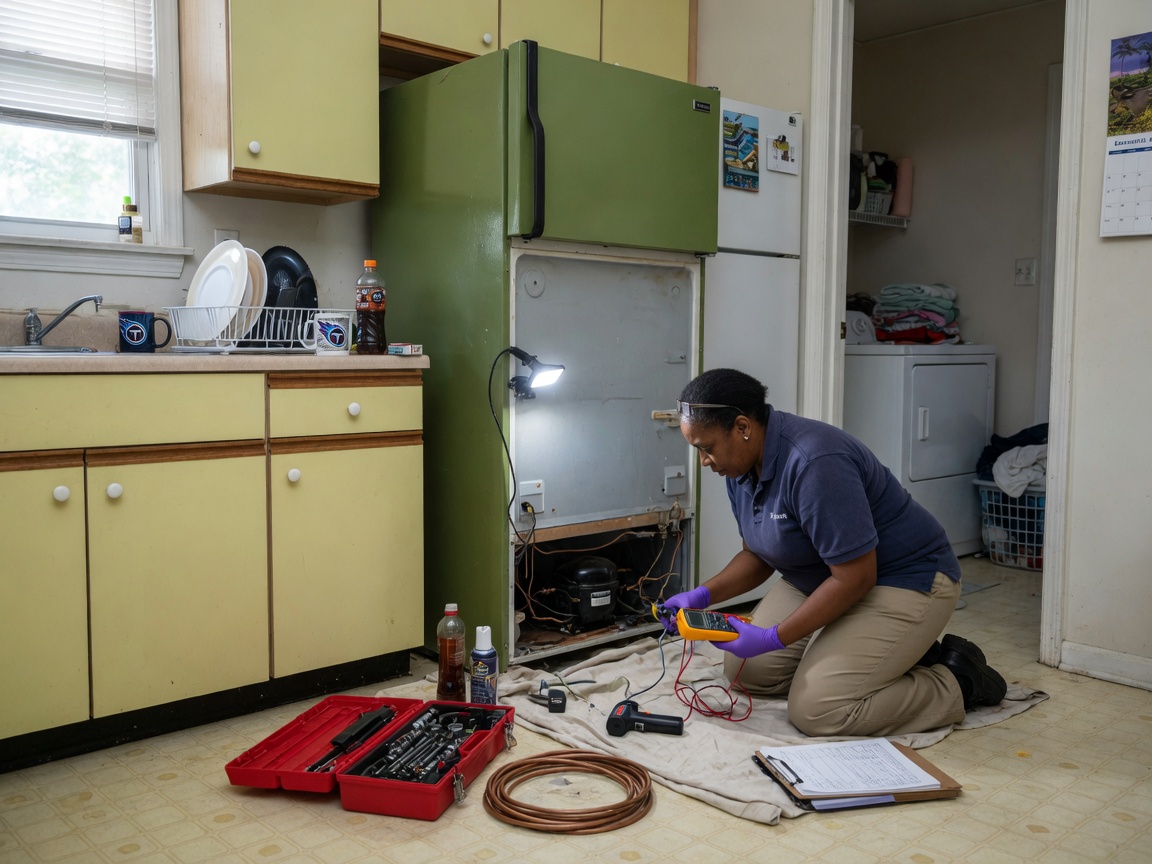
Fridge not cooling? Freezer working fine while the fridge section runs warm? Water pooling under the unit? Those are the three calls we hear most for refrigerator repair in Nashville, and each one usually points to a specific part rather than a dying appliance.
Refrigerator Not Cooling
A refrigerator that will not cool often traces to a failed start relay, a worn compressor, or a condenser coil so blocked with dust it can't shed heat. If the compressor hums but never starts, or you hear it click on and off every few minutes, that's the start relay or compressor, not something to keep running while you wait.
Fridge Not Getting Cold Enough
When the fridge section is warm but the freezer still works, the usual cause is a failed evaporator fan motor or a blocked air damper between the two compartments. A refrigerator that's cooling but never getting cold enough can also mean a torn door gasket letting cold air escape, which makes the compressor run longer than it should just to keep up.
Water on the floor is often a clogged defrost drain, a cracked drain pan, or a leaking water inlet valve that feeds the ice maker. A frosted-over evaporator coil behind the freezer panel usually means a failed defrost heater or defrost thermostat isn't letting the coil clear itself between cycles, which is the same cause behind most freezer repair calls we get.
Before assuming the worst: confirm the unit is plugged in and the breaker hasn't tripped, check that the temperature dial hasn't been bumped, and look at the condenser coils underneath or behind the fridge for a coating of dust and pet hair. Clear anything inside the freezer that's blocking the vents into the fridge compartment. Our refrigerator not cooling guide walks through the same checks in more detail.
Stop and call once you've ruled out a tripped breaker and blocked vents and the unit still won't cool, if the compressor cycles on and off rapidly, or if you notice scorch marks or a burning smell near the back panel. Sealed system work involving refrigerant isn't a DIY repair, and neither is chasing a persistent ice maker problem past the basics (see ice maker repair if that's the symptom).
We see this across Nashville and Davidson County, from older homes in East Nashville with a fridge that runs longer hours through humid summers, to newer builds in Brentwood or Franklin with side-by-side and French-door models that lean more on control boards than a mechanical thermostat. The list of likely causes stays short either way: airflow, a defrost part, a fan motor, or the sealed system itself.
Refrigerator Leaking Water: What to Do Right Now
If water is spreading toward a hardwood floor, stop the source first. Shut off the water supply valve to the fridge. It is usually behind the refrigerator or under the nearest sink, and turning it clockwise until it stops closes it. Then soak up what's on the floor with towels, lifting the edges of any rugs, and wipe under the unit as far as you can reach. If the drain pan under the fridge is accessible, slide it out and empty it.
Unplug the fridge if water is near the outlet or the cord, and move food to a cooler if it will be off for a while. A steady drip usually comes from a leaking inlet valve or supply line, which is why shutting the valve helps. Water inside the drawers or a frozen-over freezer floor points to a clogged defrost drain. Call (615) 412-2497 and tell us which one you're seeing.
Refrigerator Beeping or Showing a Temperature Alarm
A fridge that keeps beeping is telling you something is off. The two simple causes are a door that isn't fully closed and a gasket that no longer seals. The third is a warm-up from a power outage or from loading a lot of room-temperature food, which can trip the alarm until the box pulls back down.
Start with the basics. Close both doors firmly and make sure nothing in a drawer or on a shelf is holding one open. Look along the gasket, the rubber strip around the door, for gaps, tears or a hardened edge. Read the displayed temperature, then give the fridge a few hours to recover if the power was off or you just loaded a lot of groceries. Don't judge it in the first few minutes.
If the alarm keeps going after that, or the temperature on the display keeps climbing, treat it as an early sign of a cooling failure: a fan, a defrost part, the control board or the sealed system. A displayed error code is worth writing down, but we won't guess what it means over the phone. Move perishables to a cooler and call (615) 412-2497.
Refrigerator Completely Dead or Won't Turn On
No light, no hum, no fan: start at the wall. Check that the plug is fully seated and that the outlet works by plugging in a lamp. Reset the breaker, and if the outlet is a GFCI type, press its reset button. Middle Tennessee storms cause outages, and a surge or the restart afterward can trip a breaker or leave the fridge dead even after the lights come back on.
If the outlet and breaker are fine and the fridge still shows nothing, the fault is usually inside the unit. A failed control board or main power board is a common cause. Keep the doors closed to hold the cold, and don't open the back panel. If the outlet keeps tripping, or you suspect the wiring rather than the appliance, see our page on appliance power problems. Otherwise call (615) 412-2497.
Refrigerator Making Loud Noises
A buzz, rattle or scrape from the fridge usually comes from a short list of parts. A worn evaporator fan motor, or a fan blade hitting ice that has built up behind the freezer panel, scrapes and rattles. A condenser fan motor near the compressor buzzes or whirs when it wears out or clogs with dust. A single click every few minutes, with the fridge slowly warming, often points to the compressor start relay.
The safe first check is to unplug the fridge, look for a loose drain pan or something touching the back panel, and clear dust from the condenser area. Don't pry off the freezer panel to chip out ice yourself. Stop and call if the noise is a hard grinding or scraping, the fridge is warming up, or you smell anything burning.
Whether an older refrigerator is worth repairing usually comes down to the age of the compressor, what the failed part costs, and whether it's a standard or built-in model. We walk through that with you before any work starts. Call (615) 412-2497 if your refrigerator isn't cooling, is leaking water, or is showing error codes you can't explain.
Technician insight
A condenser coil that hasn't been cleaned in a while is one of the more common things people miss with refrigerator repair. Dust and pet hair building up on the coil make the compressor work harder and can look like a bigger failure than it actually is.
A common call
A common call involves a refrigerator that keeps the fresh food section cold but lets the freezer run warm, or the reverse: a cold freezer with a fridge section that never gets cold enough. That pattern usually points to a failing evaporator fan or a blocked air damper, not the compressor itself.
Refrigerator Repair Services We Offer
✓Sealed System and Compressor Repair
We test system pressures and check the compressor, start relay, and drier for the fault before recommending a repair or a refrigerant recharge.
✓Ice Maker and Water Dispenser Repair
Clogged inlet valves, frozen fill tubes, and worn auger motors are each tested individually so the actual cause of a slow or stopped ice maker is identified.
✓Evaporator and Condenser Fan Replacement
A blocked condenser coil or a failing evaporator fan motor can leave the fridge warm while the compressor keeps running; we check both before replacing parts.
✓Defrost System Repair
A failed defrost thermostat or heater keeps frost from clearing and eventually ices over the evaporator coil; we test the heater, thermostat, and timer or board together.
✓Control Board Replacement
Board and inverter faults are isolated with a multimeter and checked against the wiring harness before a replacement board is installed.
✓Door Seal and Gasket Replacement
A torn or hardened gasket lets cold air escape and makes the compressor work harder; we measure the opening and fit the correct replacement profile.
✓Built-In and Panel-Ready Refrigerator Service
Panel-ready and built-in units need careful panel removal and sealed-system access, and we account for that extra step when diagnosing these models.
How it works
- 1
On-Site Diagnosis
We confirm power and temperature settings, then listen for the compressor and fans and check the start relay and control board.
- 2
Component Isolation
The evaporator fan, defrost thermostat, and water inlet valve are tested individually so only the part that actually failed gets quoted.
- 3
Repair or Replace Decision
Age, part cost, and whether the unit is standard or built-in all factor into whether repair or replacement makes more sense.
- 4
Parts and Completion
Once you approve the repair, we install the part and test the unit through a full cooling cycle before we finish.
Pricing
What a refrigerator repair costs depends on which part failed and whether the sealed system is involved. We explain what we found and what the repair involves before any work begins, so you know what you're approving.