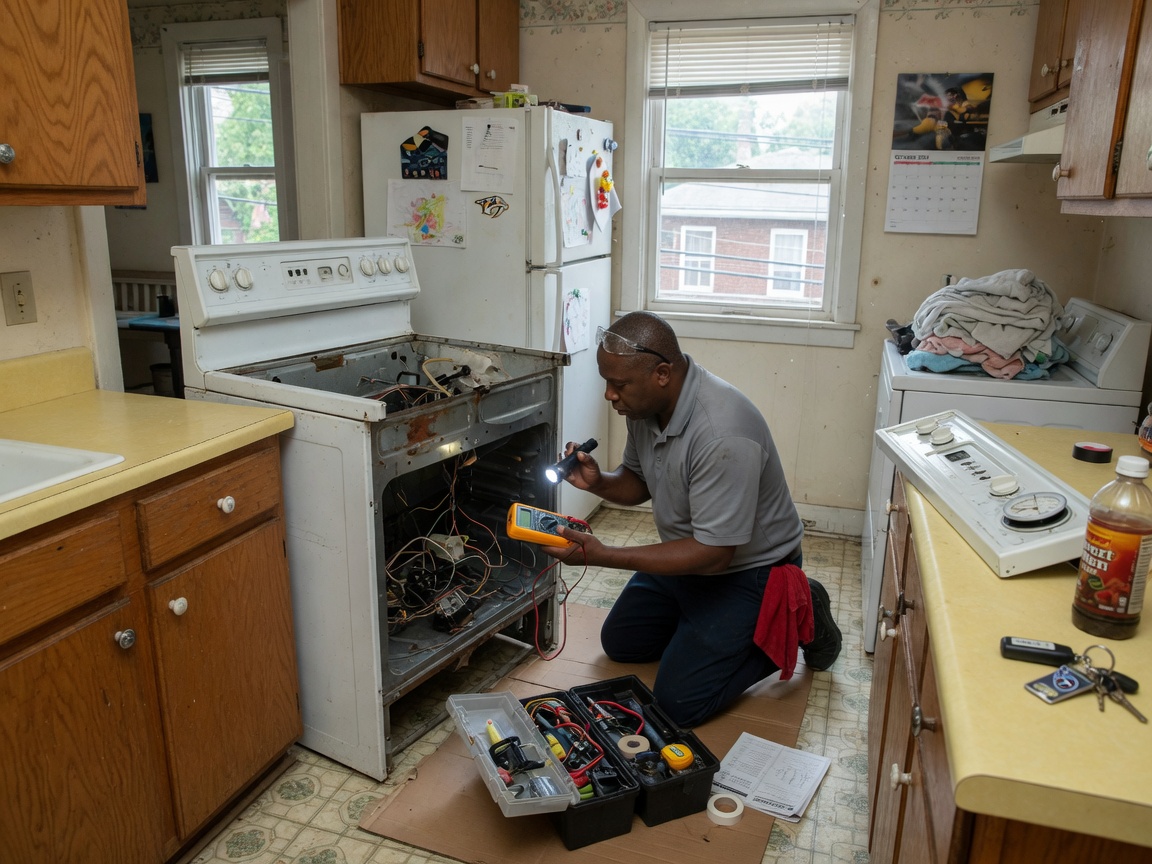
An oven or stove that will not heat past a certain point, a burner that clicks without lighting, a range display showing an error code, or a self-clean cycle that will not release the door latch usually points to one failed part rather than a worn-out appliance.
Oven Not Heating Up
On electric ranges, the most common cause of no heat is a bake element that has burned through, or a hidden broil element that fails after years of use. An oven that heats unevenly or runs hot or cold can point to a bad thermostat, a failed temperature sensor, or a control board that no longer reads the sensor correctly. A control board can also fail on its own after a power interruption, sometimes producing a sensor-fault code even though the sensor itself is fine.
Gas Oven Not Heating Or Won't Light
On gas ranges, a burner or oven igniter that glows weak and orange instead of bright and steady usually cannot draw enough current to open the gas valve, so the burner clicks but never lights. A burner valve or manifold problem can also cause an uneven or lazy flame. If the burner trouble is on a separate cooktop set into the counter, cooktop repair covers that. If you ever smell gas at the range, do not try to light it or attempt any repair. Leave the home and call the gas utility from outside.
Before calling for service, a few checks are safe to do yourself. Confirm the breaker for the range has not tripped, check that the oven door switch is fully closed and latched, and try resetting a stuck self-clean lock by turning the range off at the breaker for a minute. These checks rule out the simplest causes without opening the appliance.
Stop and call a technician if a breaker trips repeatedly when the oven is on, if you see scorching or melted insulation near the terminal block or plug, or if there is any smell of gas. Those are signs the wiring, connection, or gas supply needs a proper inspection rather than a do-it-yourself fix. Call (615) 412-2497 if you notice any of that.
Diagnosis on an oven or range starts with testing the specific part, such as the element, igniter, thermostat, or control board, rather than replacing parts by guesswork. Having your model number ready when you call helps us narrow down the likely part before the visit.
Middle Tennessee's storm season brings brief power flickers that can trip a range's control board without tripping the breaker itself. If the display resets, a sensor-fault code appears, or the clock is blinking after a storm, that alone can explain an oven that suddenly stops heating even though every element still tests fine. Older Nashville and Davidson County homes with dated panels are also more likely to trip a range's breaker under normal cooking load, which is worth ruling out before any part is replaced. If the whole range is dead after a storm, or the breaker will not stay on, that is an appliance power problems question before it is a parts question.
Stove Burner Not Working
One burner dead while the oven works fine is common, and the cause depends on the type of stove.
On an electric coil stove, the coil may not be seated in its receptacle, the receptacle may be burned, the coil itself may have failed, or the infinite switch behind the knob may be worn out. With the stove off and the coil cool, unplug the coil and push it firmly back in. Look at the receptacle and the coil's metal prongs for black burn marks or pitting. If a coil from another burner of the same size works in the dead spot, the original coil is the problem. If the good coil fails there too, the receptacle or the switch is at fault.
On a smooth glass top, a burner that stays cold usually means a failed radiant element or the switch that feeds it. If the glass itself is cracked, do not use that burner. A cracked glass top is a replacement part, not something that can be patched, and cooking on it can let spills reach the wiring underneath. Turn the range off at the breaker and call. If a new glass top has you weighing a new stove, repair or replace lays out how to think it through.
On a gas stove, a burner that clicks but never lights points to a weak igniter or a valve problem, covered in the gas section above. Do not take gas parts apart yourself. If you smell gas, do not light anything. Leave the home and call the gas utility from outside.
Stop and call if a receptacle is melted or blackened, if the breaker trips when you turn a burner on, or if a knob sticks or will not turn off. Call (615) 412-2497.
Wall Ovens And Double Ovens
When one oven in a double wall oven or double range works and the other does not, the fault is usually in the cavity that stopped, not the whole unit. That cavity's bake element, temperature sensor, or relay on the shared control board is the likely cause, since the other half still gets power and still reads its own sensor correctly. A bottom oven that stays cold while the top heats is a common version of this.
Wall ovens are built into the cabinet and wired directly, so access matters. We turn the power off at the breaker and slide the oven out of the cabinet carefully to reach the wiring and the control board, and the cabinet opening and trim decide how much room there is to work. Please do not try to pull a wall oven out yourself. They are heavy and the wiring behind them is live until the breaker is off.
For oven, stove, and range repair in Nashville, Davidson County, and the surrounding Middle Tennessee area, call (615) 412-2497.
Technician insight
A common mix-up with oven and range repair is assuming a dead element caused the problem, when a tripped breaker or a weak circuit can produce the same symptom. Checking the power supply first avoids replacing a part that was never the problem.
An oven stops heating after a power interruption
A common call: the elements test fine, but the control board no longer responds after a brief power interruption. This is a typical pattern when a board fails on its own rather than the heating element itself.
Oven & Range Repair Services We Offer
✓Bake and Broil Element Replacement
Technicians test the element for continuity and voltage at the terminals, then replace a bake or broil element that no longer heats evenly or has failed completely.
✓Gas Range Igniter Repair
A weak or cracked igniter is replaced after testing confirms it no longer draws enough current to open the gas valve, which is a common reason a burner or oven will not light.
✓Control Board and Relay Replacement
Main boards and relay boards are checked using error codes and a visual inspection for heat or electrical damage, then replaced when testing confirms the failure.
✓Thermostat and Temperature Sensor Service
Oven temperature is checked against a calibrated probe before a thermostat or sensor is replaced, because an inaccurate reading can come from either part.
✓Power Supply Check
We confirm the range is getting full power at the terminal block before replacing any part. If the problem is the circuit or house wiring, we tell you so an electrician can take a look.
✓Door Latch and Lock Assembly Repair
A stuck self-clean lock or a failed door latch switch is replaced so the oven can complete a self-clean cycle and return to normal use.
How it works
- 1
Safety And Power Verification
The technician confirms the range is getting power at the breaker and terminal block before testing any component.
- 2
Symptom Isolation
Error codes, temperature checks, and a visual inspection narrow the fault to the element, igniter, thermostat, or control board.
- 3
Component Testing
Resistance, amperage, and voltage readings are taken on the suspect part to confirm failure before a replacement is ordered or installed.
- 4
Repair And Verification
The part is installed and the oven or range is run through more than one cycle to confirm even heating and correct operation.
Pricing
Cost depends on which part has failed, such as an element, igniter, thermostat, or control board, and whether a replacement part needs to be ordered. We explain what we find and what the repair involves before any work starts.