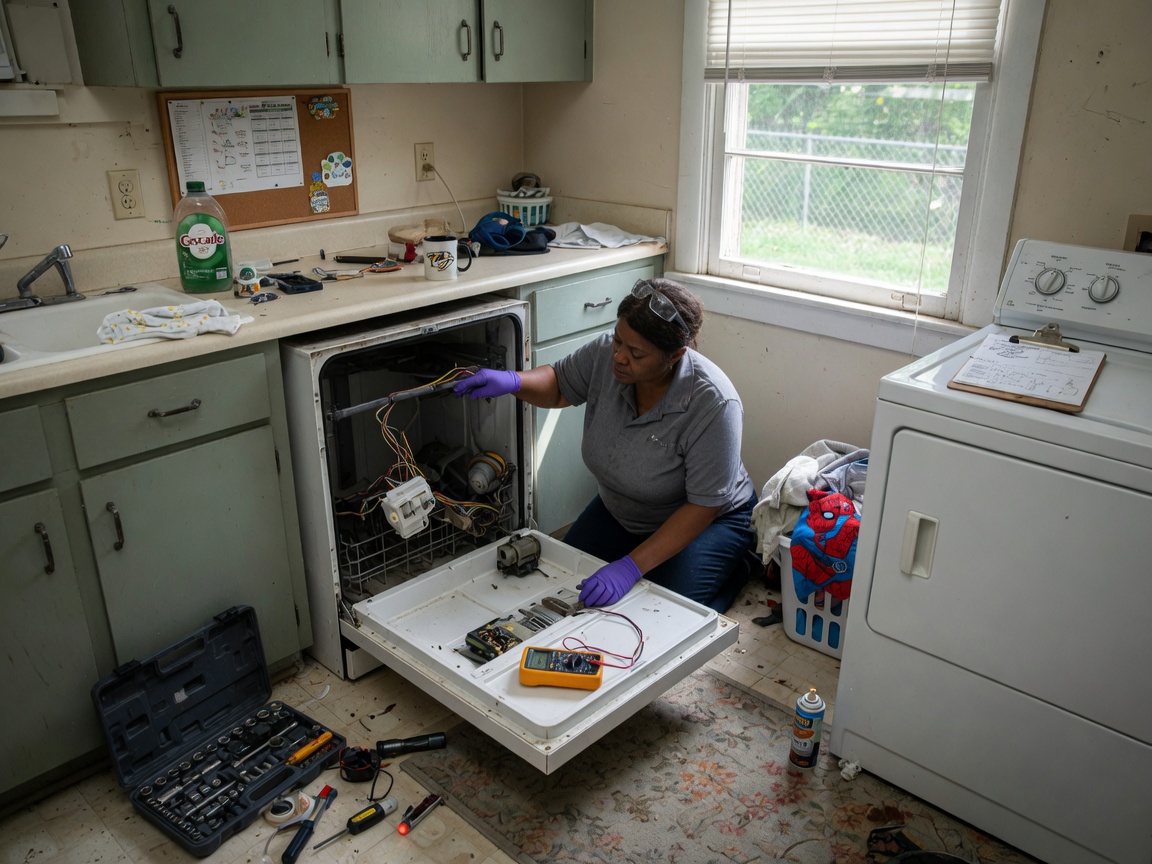
A dishwasher that leaves standing water in the bottom, leaks onto the floor, does not fill, will not start, or finishes a cycle without actually cleaning the dishes is showing one of a handful of common failures. Some units make a new grinding or humming noise, others trip a breaker, and some stop mid-cycle and display an error code. The symptom is the first clue to what has actually failed.
Dishwasher Not Draining Or Water Left In The Bottom
Standing water after a cycle is most often a clogged filter or a failed drain pump. GE and Whirlpool dishwashers fail the same way as other brands here: food debris jams the pump impeller or fills the filter basket until water cannot clear the tub. Error codes that reference fill time or drainage typically confirm a mechanical fault before the control board is suspected. If the dishwasher drains through the garbage disposal, a clogged disposal, or a new one with the knockout plug still in, can push water back into the tub. That is a garbage disposal repair job, not a dishwasher fault.
Dishwasher Not Cleaning Dishes
Dishes coming out wet, cloudy, or coated in film can point to a heating element that is not reaching temperature or scale buildup restricting the spray arms. A dishwasher that will not start at all is frequently a door latch that is not engaging the safety interlock, while leaks under the unit often trace back to a worn door seal or a cracked hose.
Before calling for service, check that the breaker has not tripped and that the door latches fully, because many dishwashers will not run at all if the interlock does not engage. Pull and clean the dishwasher filter at the bottom of the tub, because a clogged filter is one of the most common reasons dishes come out dirty or water is left behind. Check that the water supply valve under the sink is open.
Some problems are not worth troubleshooting further on your own. A dishwasher that leaks steadily, especially if water is reaching the subfloor or nearby cabinetry, should be shut off and disconnected from its water supply until it can be checked. A burning smell, visibly melted wiring, or a unit that trips the breaker repeatedly should not be run again. Call (615) 412-2497 if you see any of that.
Dishwasher Smells or Makes a Grinding Noise
A dishwasher that smells is usually holding old food. It collects in the filter, the sump under the filter, or the low loop of the drain hose, and water left standing after a cycle makes it worse. Pull the filter, rinse it under the tap, and check the sump for debris or a bit of broken glass. A clean filter and a clear sump fix most odors. If water is still sitting in the tub afterward, the drain pump or hose needs a look.
Grinding usually means something hard is caught in the pump or chopper: a piece of glass, a bone, a fruit pit. It can also be a worn circulation or drain pump motor. Stop the cycle, switch the dishwasher off, and check the filter and sump. If the noise continues with nothing in there, the pump is likely failing.
A burning smell is different. Stop the dishwasher, turn it off at the breaker, and do not run it again. Call (615) 412-2497.
Bosch Dishwasher Showing E15
On Bosch dishwashers, E15 means the leak-protection system has detected water in the base pan under the tub. The unit stops, and it may run the drain pump to try to clear the water. The leak itself has to be found and fixed. Common sources are a door seal, a hose, or a pump seal.
Tipping the dishwasher to drain the base pan only clears the code for a while. The water comes back if the leak is still there, so find the source before running it again. Our Bosch appliance repair page covers the brand in more detail, and you can call (615) 412-2497 to have it diagnosed.
Dishwasher Leaking or Tripping the Breaker
A dishwasher that leaks and trips the breaker may have water reaching wiring, the pump motor, or the control board. Do not keep resetting it. Turn the dishwasher off at the breaker, shut the water supply valve under the sink, and call (615) 412-2497.
When a dishwasher and a garbage disposal trip the same circuit, the cause is either water getting into the wiring of one of them or a shared circuit that is overloaded. Both units often run from the same line under the sink. Leave them off and call. We look at the garbage disposal and the dishwasher together, and a circuit that keeps tripping is covered on our appliance power problems page.
Cloudy film or white spots on your glasses, or dishes that come out wet, are common in Nashville because Metro Water Services draws the city's water from the Cumberland River, and its 2024 water quality report puts that water in the moderately hard range. Hard water leaves scale that coats the heating element until it stops reaching temperature, and it narrows the spray arm holes and the inlet valve screen so the tub fills slowly or cleans poorly. Start with the safe checks: pull and clean the filter, look at the spray arm holes for white crust and clear them, and use rinse aid. If the tub is still slow to fill or the water is still not getting hot after that, stop and call us, because then the problem is the inlet valve or the heating element.
During a service visit, power and water supply are checked first, then the circulation pump, drain pump, door latch, and heating element are tested in sequence to isolate the fault. Spray arms and inlet screens are checked for scale or debris, because mineral buildup can restrict flow enough to mimic a pump failure. A full cycle is run at the end to confirm the fix holds under normal use. If the trouble began right after a new dishwasher went in, the drain hose routing or hookup is the first thing to look at, and our appliance installation page covers that work.
Parts such as drain pumps, inlet valves, and door latches are common, contained repairs. When a control board has failed, or several components are failing on an older unit, the technician explains the tradeoff between the cost of the repair and the cost of replacement so the decision is an informed one.
Appliance Repair Pros handles dishwasher repair for homes across Nashville and Davidson County. For a dishwasher that will not drain, will not start, or is leaking, call (615) 412-2497.
Technician insight
One thing that catches homeowners out with dishwasher repair is assuming a leak or a no-start problem means the whole unit needs replacing. A door latch that is not engaging the interlock, or a clogged filter causing standing water, can look like a bigger failure than it actually is.
A Common Call: Standing Water After Every Cycle
A common call involves water left in the bottom of the tub after every run. Testing usually starts with the filter and the drain pump, because a clogged filter or a pump impeller jammed with debris accounts for most of these calls. Clearing the sump and confirming the pump turns easily typically resolves it, though a control board is checked when the pump tests normal.
Dishwasher Repair Services We Offer
✓Circulation Pump Replacement
Restores water pressure through the spray arms when weak or uneven flow is leaving residue on dishes after a full cycle.
✓Heating Element Repair
Tests and replaces a heating element that is not reaching temperature, a common reason dishes come out wet or a cycle runs longer than normal.
✓Drain Pump Service
Clears the cause of standing water and odors in the tub, most often a pump impeller blocked by food debris or mineral buildup.
✓Water Inlet Valve Replacement
Addresses slow fills or overflow by clearing or replacing a valve and screen restricted by mineral deposits.
✓Door Latch and Seal Replacement
Repairs a latch that will not engage the safety interlock or a seal that is letting water leak at the front of the unit.
✓Control Board Diagnostics
Confirms whether an unresponsive panel or a repeating error code is a sensor issue or a board fault before any part is ordered.
✓Spray Arm and Nozzle Cleaning
Clears scale and debris blocking the jets so water reaches every rack evenly.
How it works
- 1
Initial Symptom Check
The technician listens to what the dishwasher is doing and checks any error codes before opening the unit.
- 2
Power and Water Supply Test
Voltage at the control board and water pressure at the inlet valve are checked to rule out supply issues before testing components.
- 3
Component Isolation
The pump, heating element, and door latch are tested in sequence until the fault is confirmed.
- 4
Repair and Function Check
The needed part is replaced and a full cycle is run to confirm the fix holds before the technician leaves.
Pricing
The cost of a dishwasher repair depends on which part has failed, such as a pump, valve, latch, or board, and how much access the unit requires. A technician explains what is wrong and what the repair involves before any work begins.