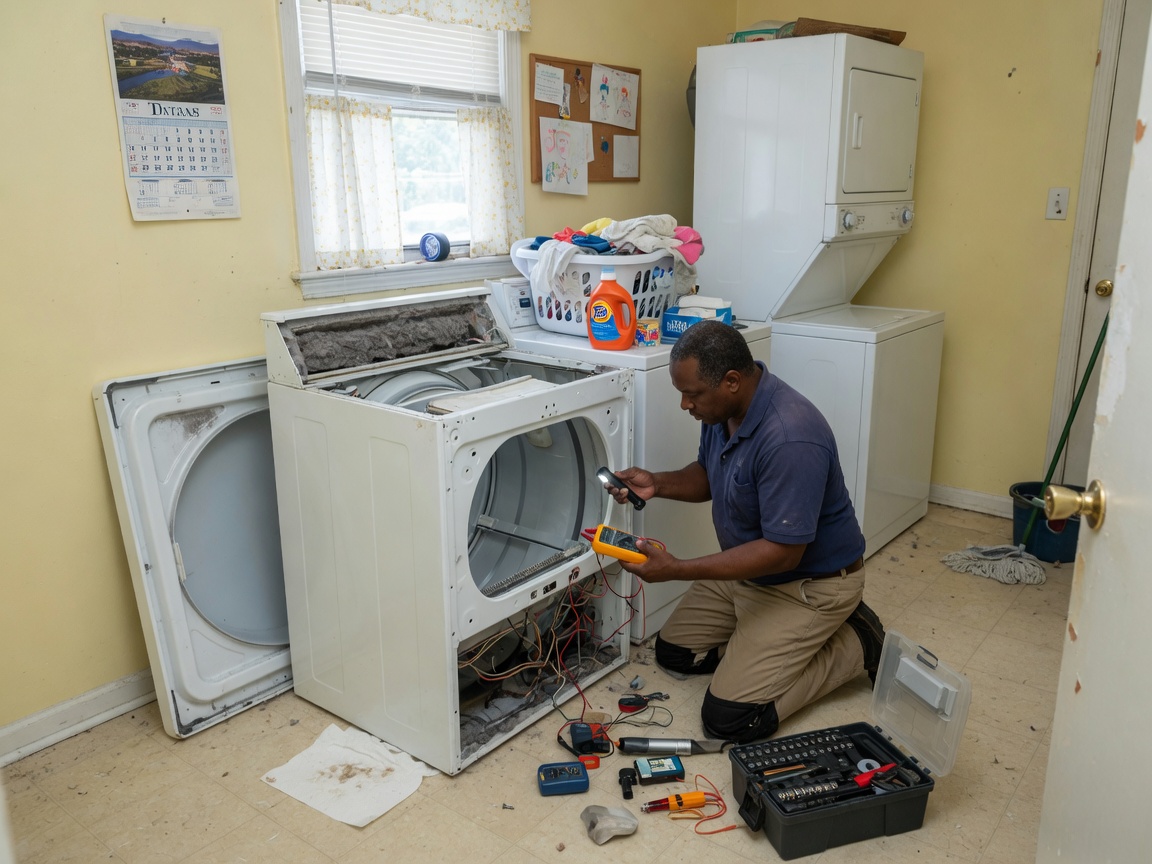
Most calls for dryer repair in Nashville start with one of a few symptoms: dryer not heating, dryer not getting hot, dryer not drying even though it runs, or a unit that shuts off partway through a load. Some dryers develop a new squealing or thumping noise, some run but the drum won't turn, and others trip the breaker or blow a fuse repeatedly. Call (615) 412-2497 to describe what yours is doing before we schedule a visit.
Dryer Not Heating or Not Getting Hot
A dryer not heating or not getting hot on an electric model is often a failed heating element or a blown thermal fuse. On a gas dryer, no heat more often traces back to a failed igniter or a gas valve that isn't opening, which is the most common reason for a gas dryer repair call. Confirm the breaker hasn't tripped and, on electric dryers, that both halves of the 240-volt circuit are supplying power, because a dryer can start and tumble on half power with no heat. Our guide on why a dryer stops heating walks through the checks in order.
Why Is My Dryer Not Drying
Why is my dryer not drying even though it runs and feels warm? Longer dry times and a hot-running cabinet point toward restricted airflow, usually lint packed in the vent run rather than a failed part. Squealing or thumping is commonly worn drum rollers, a glide, or a stretched belt. Repeated thermal fuse failures almost always mean the vent is restricted and the fuse is doing its job by cutting power before the dryer overheats.
Before calling for service, a few checks are safe to do. Clean the lint trap and check that the exterior vent flap opens and closes smoothly when the dryer runs. On gas dryers, do not attempt to work on the gas line or igniter directly; that is a job for a technician.
Lint that collects inside the vent run, not just the trap, is a genuine fire risk. Long vent runs, runs with several turns, or sections that have been crushed behind the dryer restrict airflow and let lint build up sooner than most homeowners expect. Clean the lint trap before every load, not just when it looks full, and have the full vent run checked periodically, especially in older homes where the run is long or hard to reach. If a dryer ever smells hot, has noticeably hot air coming from the outside vent hood, or the cabinet itself feels unusually warm, stop using it and shut it off or unplug it until it has been checked.
A vent duct that has pulled loose or been crushed behind the dryer is easy to miss. Hot, damp air and lint then blow into the laundry room or into the wall cavity instead of outside, which adds moisture and is a fire risk. Unplug the dryer and look behind it. If the duct is a simple slip-on connection that has just come apart, you can push it back on and secure it. If the duct is crushed, torn, or runs into a wall or ceiling, leave it and call (615) 412-2497.
A few situations call for a technician rather than more troubleshooting. A dryer that trips the breaker repeatedly, smells like burning insulation, sparks, or smokes should be shut off immediately and not run again until it is inspected. A gas dryer that smells like gas should not be operated: leave the house and call the gas utility from outside. Repeated thermal fuse failures even after the vent has been cleaned are also a sign to have the unit looked at rather than keep replacing the fuse.
During a service visit, the thermal fuse, high-limit thermostat, heating element or igniter, and the vent path are checked before deciding what needs to be replaced. Drum rollers, idler pulleys, and belts are inspected when there is noise or slow tumbling. On older units, the age of the dryer and the cost of the failed part both factor into whether repair or replacement makes more sense, and that gets discussed before any part is ordered.
Dryer Won't Start or Shuts Off Early
A dryer that shuts off before the load is dry often has coated moisture sensor bars inside the drum, which read the clothes as dry too soon. It can also be overheating from a blocked vent, so the thermostat cuts power. Clear the vent run, because a restricted vent is a fire risk. A dryer that won't start at all usually has a bad door switch, a failed thermal fuse or start switch, or a tripped double breaker on an electric model.
The safe first check is to wipe the sensor bars with a damp cloth, make sure the door latches fully, and reset the breaker. Turn it fully off, then on. Stop and call if the breaker trips again, the dryer hums without turning, or the cabinet is hot.
Dryer Running but the Drum Won't Turn
You press start, the dryer sounds like it is running, and the drum sits still. Or the drum turns slowly, or stops partway through a load. The most common cause is a broken or stretched drive belt, which loops around the drum and the motor pulley. The next suspect is the idler pulley, the spring-loaded wheel that keeps tension on that belt. A worn drive motor is less common, but it can hum and fail to turn the drum.
Here is a safe check. Unplug the dryer, open the door, and try turning the drum by hand. If it spins with almost no resistance, the belt has most likely broken or slipped off. If it feels stiff, grinds, or catches, something else is binding and the dryer should not be run again until it is looked at.
Stop and call if you smell burning, if the motor hums but the drum doesn't move, or if the dryer has been running with a stuck drum. Don't keep running it to see if it catches. A motor that can't turn the drum overheats, and a slipping belt can scorch from friction. Call (615) 412-2497 and we will work out which part has failed.
Dryer Squeaking, Thumping or Making a Loud Noise
A squeak that rises and falls with the drum turning usually points to a worn idler pulley or dry drum rollers. A rhythmic thump with each turn often means a flat spot on the belt from sitting still, or a worn drum glide or felt seal at the front or back of the drum. A rattle or clunk can be as simple as a sock, coin or button caught between the drum and the cabinet. Empty the drum and check the lint trap housing first.
Stop and call if the noise is grinding or screeching, if you smell something hot, or if it gets louder from one load to the next. These parts wear together, so we check them as a set. Call (615) 412-2497.
Appliance Repair Pros handles dryer repair for homes across Nashville, Davidson County and nearby towns including Franklin. If you need to repair a clothes dryer that's not heating, not drying, or smells unusual, call (615) 412-2497. For the washer in the same laundry pair, see washer repair.
Technician insight
One thing that catches homeowners out is assuming the dryer itself has failed when the real problem is a restricted vent. A dryer can trip its thermal fuse repeatedly, run hot, or take much longer to dry simply because lint has built up in the vent run rather than in the trap.
A Common Call: No Heat After a Tripped Fuse
A common call involves a dryer that tumbles normally but stopped producing heat, sometimes after the breaker tripped once. Testing usually starts with the thermal fuse and the vent run together, because a blocked vent is the most frequent reason the fuse blew in the first place. Where the vent run is also long or has several bends, clearing it is part of keeping the same failure from happening again.
Dryer Repair Services We Offer
✓Heating Element Replacement
The heating element is tested for continuity and checked against voltage at the connector before it is replaced. A no-heat or low-heat complaint on an electric dryer often traces back to this part once the thermal fuse tests normal.
✓Thermal Fuse and Safety Switch Repair
A blown thermal fuse is confirmed with a continuity test. Because fuses usually blow due to restricted airflow, the vent run is checked at the same time so the new fuse is not immediately at risk of blowing again.
✓Vent Cleaning and Airflow Restoration
The vent run from the dryer to the outside termination is cleared of lint. A restricted vent causes longer dry times, a hot-running cabinet, and repeated thermal fuse failures, and left alone it is also a fire risk.
✓Drum Roller and Belt Service
Worn rollers, a dry glide, or a stretched belt cause squealing, thumping, or slow tumbling. These parts are checked together because wear on one often speeds up wear on the others.
✓Gas Dryer Repair and Ignition Service
Igniters and gas valves are tested for proper operation when a gas dryer tumbles but produces no heat. Work on gas components is handled by the technician only.
✓Control Board and Sensor Replacement
When error codes or inconsistent cycles point to the moisture sensor or main control board, those components are tested with the dryer running before any part is ordered.
How it works
- 1
Intake and Safety Check
The technician listens to what the dryer is doing, checks the power supply, and on gas units confirms there is no gas odor before any panel is removed.
- 2
Component Testing Sequence
The thermal fuse, heating element or igniter, moisture sensor, and control board are tested in the order most likely to explain the symptom.
- 3
Vent Inspection
The vent run is checked for restrictions, crushed sections, or lint buildup, because airflow problems cause many of the same symptoms as a failed part.
- 4
Repair Decision and Final Check
The technician explains what failed and what the repair involves, then confirms the dryer heats, tumbles, and vents properly before finishing.
Pricing
The cost of a dryer repair depends on which part has failed, such as a fuse, element, igniter, or board, and how much access the unit requires. A technician explains what is wrong and what the repair involves before any work begins.