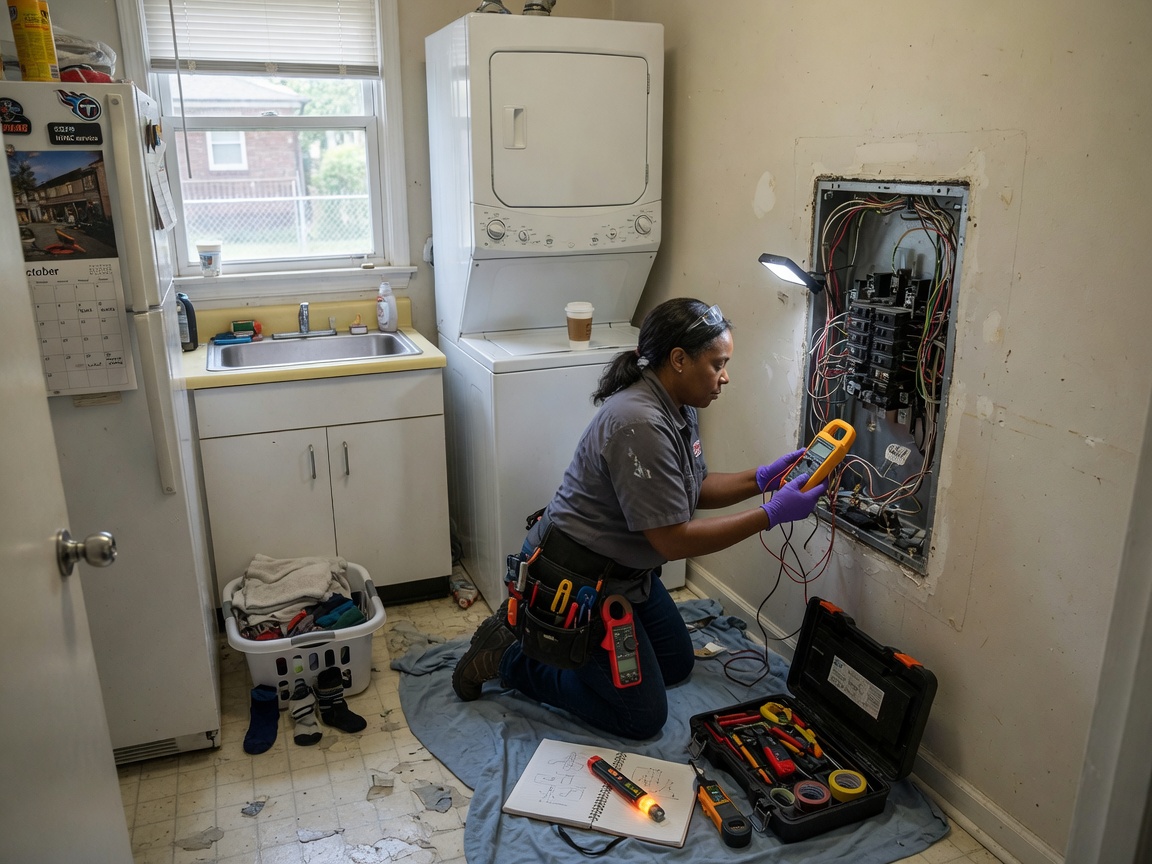
A dryer that won't start. A range that trips the breaker every time the oven comes on. A refrigerator that went dark right after the lights flickered in a storm. These look like appliance problems, and sometimes they are. Other times the appliance is fine and the fault is in the outlet or circuit behind it. We test the appliance side first and tell you which one it is.
Appliance Won't Turn On Or Trips The Breaker
Start with the easy checks. Make sure the plug is pushed all the way in, try a different outlet for anything that plugs into a regular wall socket, and look at the breaker. If a breaker has tripped once, you can reset it once. If it trips again, leave it off and call us. Resetting it over and over is how a small fault turns into a damaged wire.
If the appliance is getting power but still won't run, the fault is usually inside it: a worn cord, a loose connection, a failed switch or a control board. A dryer or range that trips the breaker every time it runs often has a short in its own wiring, not a weak breaker. We test it under load, so we are not guessing which part is at fault.
Dead After A Storm Flicker
Spring and summer thunderstorms bring outages and flickers across Nashville. A flicker can kill a control board or damage a cord connection without tripping anything at the panel. Before you call, check whether the whole street lost power. Nashville Electric Service (NES) supplies power across Davidson County, and Middle Tennessee Electric serves much of Rutherford and Williamson counties, so an outage on your block is theirs to fix, not ours.
If the lights are on and one appliance is dead, we check its connections and control board. A refrigerator that stays dark after a storm is a different job, with its own food-spoilage clock. See refrigerator repair for the control board side of that.
Hot Smell, Scorched Cords And Terminal Blocks
A dryer or electric range pulls a lot of current. The terminal block is the screw connection inside the back panel where the power cord attaches. If one of those screws is loose, the connection heats up and scorches the wire and plastic around it, a little more every time the appliance runs.
A hot smell near the back of a dryer or range, a brown mark on the plug, or a cord that is warm to the touch all point this way. On a dryer, a hot smell can also mean a lint-clogged vent, so we check that too. We repair the cord and terminal block on the appliance side. For vent and heating faults, see dryer repair. For ovens and ranges, see oven and range repair.
When It Is An Emergency
Stop and unplug the appliance if you smell burning, see a scorched cord or outlet, or find a melted plug. If it hard-wires into the wall, switch off its breaker. Do not reset that breaker again, and do not plug anything else into that outlet. Call (615) 412-2497 and tell us what you saw. If there is smoke or fire, call 911 first. For urgent appliance faults, see urgent appliance repair.
Dryer And Range Cords: 3-Prong Or 4-Prong
Older Nashville homes often have a 3-prong (3-wire) dryer or range receptacle. Newer construction uses a 4-prong (4-wire) one, since the National Electrical Code change in 1996. The cord on the appliance has to match the receptacle on the wall. A new dryer usually ships without a cord, or with the wrong one for your house, and it has to be fitted before it is plugged in.
We fit and connect the correct cord on the appliance side, and tighten the terminal block connection properly, since a cord loose at that block is what scorches. Changing the receptacle or the circuit behind it is electrician work. In Metro Nashville, circuit work goes through Metro Codes permits, and an electrician handles that. Buying a new dryer? See appliance installation for the hookup.
When The Problem Is The Home's Wiring
Sometimes testing shows the appliance is fine and the fault is in the home's wiring, panel or circuit. Older homes in neighborhoods like East Nashville, Germantown, Sylvan Park, Inglewood and Old Hickory are more likely to have older wiring. That work is outside what we do. When testing points that way, we tell you and you call a qualified electrician for the panel, circuit or wiring itself.
What Affects The Price
Cost depends on what failed and how far the damage went. A cord swap is a different job from a scorched terminal block, and both differ from a control board. A part that has to be ordered, a cord that does not match your receptacle, and damage that spread to the wire or the appliance frame all change the work. We tell you what the cost depends on before any repair starts.
Call (615) 412-2497, Monday to Saturday, 8am to 7pm, if an appliance won't power on, keeps tripping the breaker, or went dead after a storm.
Technician insight
What catches people off guard most is assuming a tripped breaker always means a panel problem. Often the short is inside the appliance itself, in the cord, a terminal block connection, or the control board, and testing the appliance first saves a call to someone who isn't the right person for the job.
A common storm-flicker call in Davidson County
A typical situation in older neighborhoods: the lights flicker during a spring storm, and afterward the dryer won't start at all. Testing shows a damaged connection at the cord rather than anything wrong at the breaker. Once that's found, the fix is straightforward. In homes where testing instead points to the wiring or panel, that part goes to a qualified electrician.
Appliance Power Problems Services We Offer
✓Won't Power on Diagnosis
Testing an appliance that won't turn on at all, checking the outlet, cord and internal connections to find where the power stops.
✓Breaker-Tripping Diagnosis
Testing a dryer, range or other appliance that trips the breaker when it runs, to see whether the fault is in the appliance's own wiring.
✓Storm Flicker Damage Check
Checking an appliance's control board and internal connections after a power flicker or brief outage left it dead.
✓Burnt Cord and Terminal Block Repair
Repairing scorched or loose connections at a dryer or range cord and at the screw connection inside the back panel, a common cause of overheating.
✓Dryer and Range Cord Fitting
Fitting and connecting a 3-prong or 4-prong cord on the appliance so it matches your home's receptacle.
✓Outlet Voltage Check at the Appliance
Checking voltage at the outlet the appliance plugs into to help separate an appliance fault from a circuit fault.
✓Referral for Home Wiring or Panel Work
When testing shows the fault is in the home's wiring, panel or circuit rather than the appliance, we tell you and point you to a qualified electrician for that part of the job.
How it works
- 1
Describe The Symptom
Tell us whether the appliance won't power on, trips the breaker, smells hot, or went dead after a storm, and we'll talk through what to check first.
- 2
Test The Appliance And Outlet
A technician checks the appliance's cord, connections and control board, then checks voltage at the outlet it plugs into.
- 3
Explain What's Causing It
We tell you whether the fault is in the appliance or upstream in the wiring or circuit, and what the cost depends on before any work starts.
- 4
Repair Or Refer
If it's the appliance, we repair the cord, connection or control board. If it's the home's wiring or panel, we point you to a qualified electrician.
Pricing
Cost depends on which part failed and whether the fix is a cord, a connection or a control board. A part that has to be ordered or damage that spread beyond the connection adds to the job. We explain the repair and what drives the cost before any work starts.