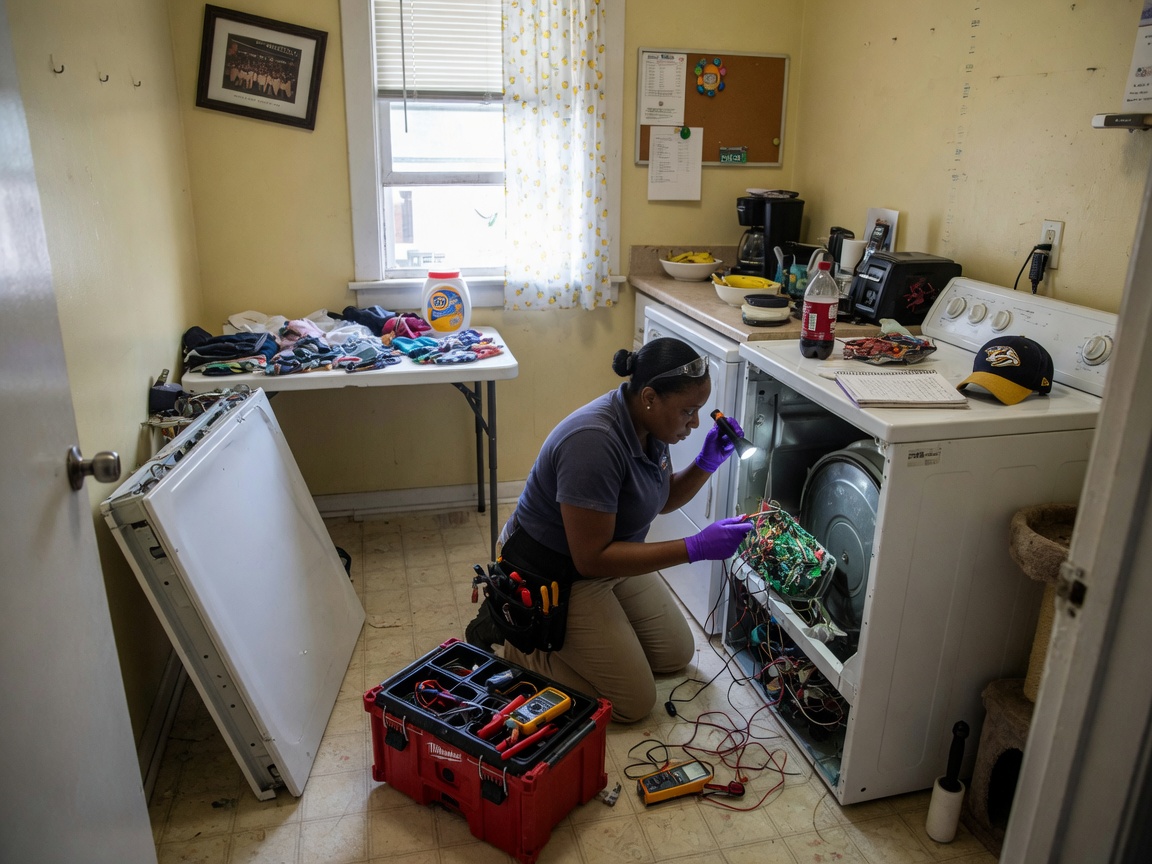
The fridge is warm inside. The washer is stuck with water in the drum. The oven won't heat and dinner is due. That is the kind of call this page is for. Tell us what the appliance is doing and we'll tell you whether it needs a visit, one safe check first, or a different phone number entirely. We take calls Monday through Saturday, 8am to 7pm: (615) 412-2497.
When it counts as an emergency
Some breakdowns can wait a day. Others can't.
Food at risk is the big one. A refrigerator that runs but isn't cooling, or a freezer that is frosting over and softening what's in it, is on a clock. Standing water is next: a washer that stopped mid-cycle with a full tub, or a dishwasher that leaves water in the bottom and could leak onto the floor. The third is anything hot or scorched. A dryer that smells burnt, or one that runs for an hour and the clothes are still damp, usually has a restricted vent or a failed heating element. A packed vent run is a fire risk, so unplug the dryer and leave it off until it's been checked.
A dead oven, a burner that won't light or a dryer with no heat is a real nuisance, but it isn't dangerous. Call when you can.
When it is not an appliance call
If you smell gas near a range or oven, stop reading and act. Piedmont Natural Gas serves Nashville, and its published instruction is to leave the area, not touch switches or anything that could spark, and call Piedmont at 800-752-7504 or 911 from a safe place. We can't help with a gas leak. Call us after Piedmont has cleared it, if the appliance still needs work.
The same goes for sparks, a burning-plastic smell from the outlet, or a breaker that trips the moment you plug something in. Unplug it, leave it off and don't keep resetting the breaker. If an appliance won't power on at all or keeps tripping the breaker, the fault may be in the machine or in the circuit behind it. Our page on appliance power problems explains how we tell the two apart. Circuit and panel faults go to an electrician.
What the problem usually looks like, and what is behind it
Start with what you see. The cause is usually one of a short list of parts.
A refrigerator that runs but doesn't cool is often a failed evaporator fan motor, or a frosted evaporator coil from a failed defrost heater or defrost thermostat. A freezer that frosts over points the same way. See refrigerator repair and freezer repair.
A washer that won't drain or stops mid-cycle usually has a blocked drain pump or a failed lid switch. A dishwasher that leaves water in the bottom is a clogged filter first and a failed drain pump second. See washer repair and dishwasher repair.
A dryer that runs but gives no heat is almost always a blown thermal fuse or a failed heating element. An oven that won't reach temperature is a failed bake element or igniter, and a burner that won't light is often the same igniter story. See dryer repair and oven and range repair.
Safe checks before you call
Check the breaker and make sure the appliance is plugged in. On a washer, look at the lid or door latch and the drain hose. On a dishwasher, pull the bottom rack and clean the filter. On a dryer, empty the lint trap and look at the vent run behind it. If the refrigerator is warm, keep the door shut and move what could spoil into a cooler with ice.
If a water line is leaking, shut off the supply valve behind the machine. If the check doesn't change anything, or you smell something hot, stop and call. Don't pull panels off a live appliance.
What the job involves
We come to the house, run the appliance and test it to find the part that actually failed. Then we tell you what broke, what the repair is and what the cost depends on, before any work starts. If the part is available locally, the repair can often be finished that visit. If it has to be ordered, we say so and set up the return trip. Once it's repaired, we run the appliance to confirm it works.
What changes the price
We don't quote a number over the phone, because the same symptom can come from a cheap part or an expensive one. What moves the cost: which part failed, the make, model and age of the appliance, how much has to come apart to reach it (a built-in dishwasher or a stacked washer and dryer is more work than a freestanding unit), whether a sealed refrigeration system is involved, and whether the part is on hand or has to be ordered. On an older appliance, we'll also say plainly when the repair costs more than it's worth.
What is different about repairs in Nashville
Nashville Electric Service supplies power across Davidson County, and spring and summer thunderstorms bring outages and flickers. Those swings are hard on the electronics inside a refrigerator. A control board that dies after a storm, or a compressor start relay that fails the day power comes back, is a common pattern. If the fridge went quiet after a storm, tell us when it happened.
Metro Water Services water is moderately hard, about 75 mg/L total hardness in its 2025 report. Over time that builds scale in the inlet valves on dishwashers and washers. A machine that fills slowly, or won't fill at all, may be a scaled inlet valve and not a bigger fault.
We work across Davidson County and nearby towns, including Donelson, East Nashville, Antioch, Madison and Brentwood.
Call (615) 412-2497, Monday through Saturday, 8am to 7pm, and tell us what the appliance is doing.
Technician insight
What catches people off guard with an urgent breakdown is assuming every failure is a quick part swap. A blown thermal fuse on a dryer is usually straightforward. A sealed refrigeration problem takes longer to diagnose properly and may need a part ordered in. And a dryer that has been running hot for months is often a vent problem to fix before the dryer itself.
A common call after a Nashville storm
A thunderstorm rolls through, the power at the house flickers or drops for a while, and by morning the refrigerator is running but the food is warm. After an outage like that, the usual suspects are a control board or a start relay, not the compressor. Calling as soon as you notice, instead of waiting to see if it corrects itself, gives you the best chance of saving what's inside.
Urgent Appliance Repair Services We Offer
✓Refrigerator Repair
Diagnosing a fridge that runs warm, cycles constantly, or has stopped cooling, usually a failed evaporator fan motor, a bad start relay, or a frosted coil from a defrost problem.
✓Washer Repair
Fixing washers that won't drain, stop mid-cycle, or leak from the front, most often a clogged drain pump, a failed lid or door switch, or a worn door seal.
✓Dryer Repair
Diagnosing dryers that run but don't heat, or that shut off early, commonly a blown thermal fuse, a failed heating element, or a restricted vent run.
✓Dishwasher Repair
Addressing dishwashers that leave standing water or won't fill, typically a clogged filter, a failed drain pump, or a stuck float switch.
✓Oven and Range Repair
Testing ovens that won't reach temperature and burners that won't light, usually a failed bake element, a bad igniter, or a faulty cycling thermostat.
✓Freezer and Ice Maker Repair
Diagnosing freezers that frost over or ice makers that stop producing, often tied to the same evaporator fan and defrost components found in refrigerators.
How it works
- 1
Call And Describe The Problem
Tell us what the appliance is doing. We'll suggest one safe check you can try before we talk about a visit, and tell you right away if it's a gas or electrical problem that needs someone else first.
- 2
On-Site Diagnosis
A technician tests the appliance in your home and identifies which part failed.
- 3
Explain The Repair And Cost
We walk through what needs to happen and what the cost depends on before any work starts.
- 4
Repair And Test
If the part is available locally, the repair is often finished during that visit. Otherwise we order the correct part and schedule a return trip.
Pricing
What you pay depends on which part failed, the appliance's make, model and age, how much has to come apart to reach it, whether a sealed refrigeration system is involved, and whether the part has to be ordered. We explain the repair and the cost before any work starts.