2026-08-29 ·
Appliance Repair or Replace? A Nashville Owner's Guide
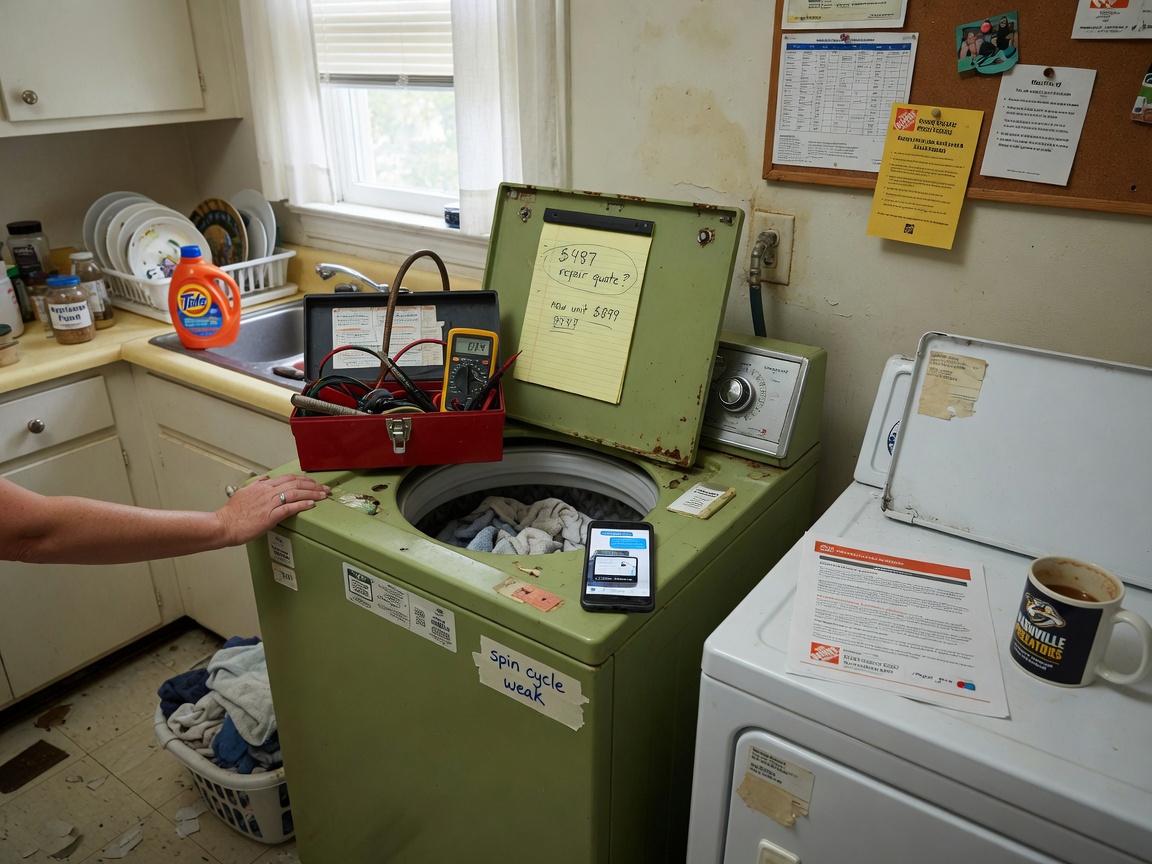
The dishwasher is leaving a puddle in the bottom. The fridge runs constantly and nothing inside gets cold. The dryer tumbles fine but never puts out heat. Whatever the symptom, the same question follows: is this worth fixing, or is it time to replace the thing?
There's no single rule that answers that for every appliance in every kitchen or laundry room. But a handful of factors, checked in order, will get you to a clear answer most of the time. Call (615) 412-2497 if you'd rather have someone look at it in person and talk through the options.
How Old Is the Appliance
Start with the model tag, usually just inside the door or on the back panel. It lists a manufacture date, not a purchase date, which matters if the unit came with a house you bought used.
Refrigerators and freezers are commonly cited as lasting roughly ten to thirteen years. Washers, dryers, and ranges are often in a similar range, sometimes a bit longer. Dishwashers tend to run shorter, since Nashville's hard water is tougher on heating elements and spray arm bearings than it is elsewhere. These are broad, typical figures, not a promise for any single unit, and plenty of appliances beat them by years while others fall short.
A unit well within its typical range with one failed part is usually worth fixing. A unit at the far end of that range, especially with a second issue already showing, tips the other way.
Which Part Actually Failed
Age alone doesn't decide it. What failed matters just as much.
A blown thermal fuse on a dryer, a worn lid switch on a washer, a bad igniter on a gas oven: these are single, well-understood parts that get swapped and the appliance runs like normal again. A failed evaporator fan motor or a frosted-over evaporator from a bad defrost heater or defrost thermostat is more involved but still usually a straightforward repair.
It's a different conversation when a control board has failed alongside a second component, or when the same fault keeps coming back after a prior repair. Stacked failures on an older unit are the clearest signal that you're financing a slow replacement one part at a time.
Is a Sealed System Involved
On a refrigerator or freezer, ask whether the compressor or sealed refrigerant system is the actual problem, not just a fan or a switch.
A sealed system repair is more labor and more involved than swapping a start relay or a condenser fan motor. On a newer unit it's still often worth doing. On a unit already well into its expected years, a sealed system failure is usually the point where most homeowners choose to replace rather than repair, since it's the most expensive single repair a refrigerator can need.
Can We Still Get the Part
Parts availability shifts the math too. If the correct part is available locally, the repair can often be finished on the first visit. If it has to be ordered, especially for an older or discontinued model, we come back once it arrives, and there's no way around that lead time.
Very old models sometimes have parts that are getting hard to source at all. If nobody stocks the control board your fifteen-year-old range needs, that alone can settle the decision regardless of what the rest of the unit looks like.
What It's Costing You to Run
Older appliances, particularly refrigerators and freezers, tend to use noticeably more energy than newer ones as compressors and seals age and lose efficiency. That's not a reason on its own to replace a unit that's otherwise healthy, but it's worth weighing alongside everything else, especially on a unit that already runs constantly trying to hold temperature.
How the Rest of the Unit Looks
Walk around the appliance and take stock. Rust creeping along the bottom of a washer tub, a gasket that no longer seals on a dishwasher door, a dryer drum that wobbles or squeals even with the belt fine: these tell you the rest of the machine is aging at the same pace as the part that just failed.
A single clean failure on a unit that otherwise looks and runs fine is a good repair candidate. A failure on a unit that's been getting steadily louder, rustier, or less efficient for a year or two is a different situation, even if the immediate fix is simple.
When to Stop and Call
Stop troubleshooting and call if you smell gas near a range or oven. Leave the appliance off and don't try to relight anything yourself; call the gas utility first, then us.
Stop and call if a dryer is producing heat but also a burning smell, or if lint has visibly built up beyond what you can reach and clear yourself, since a blocked vent run is a real fire risk. Stop and call if a refrigerator has been warm for more than a few hours, since food safety is now part of the decision. And stop and call any time a repair looks like it needs a second pair of hands, whether that's because the part is buried behind a control panel or because you're just not sure what you're looking at.
None of that means the appliance is doomed. It means the next step should be a proper look rather than another hour of guessing.
Making the Call
Put the pieces together: how old the unit is against its typical range, what actually failed, whether a sealed system is involved, whether the part is easy to source, what it's costing you to run, and how the rest of the machine looks. Most decisions become obvious once you've walked through those six things honestly.
If you're still not sure, that's a normal place to be. Refrigerator repair and dryer repair calls both start the same way here: we look at the actual unit, explain what failed and what it would take to fix, and let you decide with real information instead of a guess. Call (615) 412-2497 between 8am and 7pm, Monday through Saturday, and we'll walk through it with you.