2026-08-29 ·
Refrigerator Not Cooling? 7 Common Causes and What Each Repair Involves
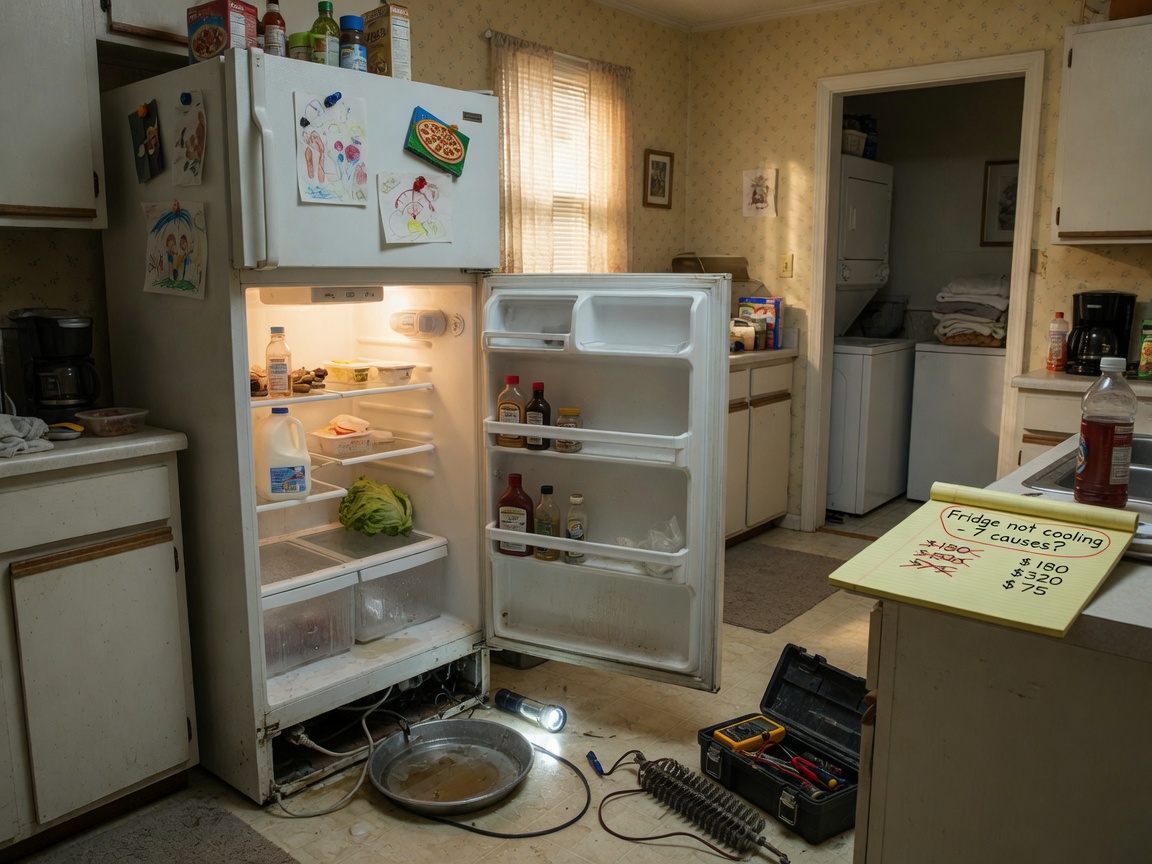
A refrigerator that's running but not cold, what most people mean by refrigerator not cooling, usually isn't a mystery once you know what to check. Fridge not cooling, fridge not chilling, and fridge not getting cold all describe the same handful of underlying failures, and matching your symptom to the right one saves a wasted visit. Call (615) 412-2497 if you want to talk through what you're seeing before scheduling anything.
The seven causes below cover most of the fridge and freezer cooling complaints we see in Nashville homes, from a compressor that's simply worn out to a control board that's stopped talking to the rest of the appliance.
A few come from ordinary wear as the appliance ages. Others show up more in certain kinds of homes, a garage refrigerator that sees cold snaps in the winter, an older unit with coils that haven't been cleaned in years, or a kitchen that lost power briefly during a storm. None of that changes how to diagnose the problem, but it's worth keeping in mind while you work through the list.
1. Compressor Failure
The compressor is the heart of the sealed system. When it fails, the refrigerator keeps running but never gets cold, and the compressor itself may hum steadily or click every few minutes without starting. This repair means recovering refrigerant, replacing the compressor, and recharging the system, so it's one of the more involved jobs on this list.
2. Start Relay or Run Capacitor
The start relay and run capacitor sit on the compressor and give it the jolt it needs to begin each cycle. A failing relay usually produces a loud click every thirty to sixty seconds while the compressor never actually starts. Replacing the relay or capacitor is a contained repair that doesn't touch the sealed system itself.
3. Condenser Fan Motor
The condenser fan pulls air across the coils, usually behind or underneath the unit. When the motor seizes, the compressor overheats and shuts itself down, and you'll notice warm air, or none at all, at the lower rear vent while the fridge light still works. Replacing the fan motor is straightforward once it's confirmed as the cause.
4. Evaporator Fan or Frost Buildup
Inside the freezer, the evaporator fan pushes cold air into the refrigerator section. A seized fan, or heavy frost from a failed defrost heater, leaves the fresh-food side warm while the freezer stays cold. This is one of the patterns behind a refrigerator working but freezer not freezing complaint too, just running the other direction: airflow between the two compartments has to work both ways, and a blockage on either side shows up as one side lagging behind the other.
5. Defrost Timer, Heater, or Thermostat
The defrost system keeps ice from building up on the coils. When the timer, heater, or defrost thermostat fails, frost blocks airflow and both compartments gradually warm up. Thick frost on the back wall of the freezer that doesn't clear during a manual defrost points here.
6. Thermistor or Temperature Sensor
The thermistor reports compartment temperature to the control board. When it drifts out of range, the board either stops cooling too early or runs the compressor longer than it needs to. This failure is easy to miss because the fridge still cools some of the time, it just does it unevenly, with food freezing one week and warming the next.
7. Main or Inverter Control Board
The control board governs the compressor, fans, and defrost cycle together. When it fails, the panel can go dark, show an error code, or stop responding to temperature changes at all. Before assuming it's the board, confirm the outlet has power and try a full reset by unplugging the unit for a few minutes. That rules out a simple glitch before anyone opens the cabinet.
Control boards fail less often than the mechanical parts above, so it's worth ruling out the simpler causes first. A technician can usually confirm a board issue quickly once the easier checks are out of the way.
What It Costs to Fix a Refrigerator That Is Not Cooling
The cost depends on which part failed and on the unit itself. What we can tell you is which kind of repair each cause on this list usually is, since that is what moves the cost most.
Small, contained parts: the start relay or run capacitor, the condenser fan motor, the evaporator fan motor, the defrost heater and defrost thermostat, the thermistor, and a worn door gasket. Each one is a single component that is replaced without opening the sealed system. On these repairs, the price of the part and how hard it is to reach are the main factors.
Boards: a main or inverter control board is usually a costlier part than the small components above and it is often ordered rather than on hand. Confirming that the board is the real fault, and not a sensor or a power problem, matters before one is replaced.
Sealed-system work: a compressor failure or a refrigerant leak means the sealed system has to be opened, repaired, and recharged. That takes more time and more specialized work than any other repair here, so it is usually the costliest kind of repair for a fridge that is not cooling.
Four things drive the final cost: the part itself, how much access the unit allows, whether the sealed system has to be opened and recharged, and whether the part has to be ordered. Built-in and panel-ready refrigerators take longer because panels, trim, or cabinetry have to come off before anyone reaches the parts behind them.
A compressor failure is the point where replacement is usually worth weighing. If the refrigerator is older, has needed other repairs already, or the sealed-system repair would be a large share of what a comparable new unit costs, replacing it can make more sense than repairing it. On a newer or built-in unit, repair is often still the better choice. We will go through both sides with you.
A word on the defrost thermostat. It is a small sensor on the evaporator coil that tells the defrost heater when to switch on and off. When it fails, frost builds up on the coil and airflow drops, so the fridge warms even though the compressor is running. It is usually a small, contained part, and the work is mostly getting to it behind the freezer panel.
If you want to talk through your symptoms, call (615) 412-2497 or see our refrigerator repair page.
When to Stop and Call
A refrigerator that's merely running warm can usually wait a day for a scheduled visit. A few signs mean it's worth calling sooner: food that's already spoiling, water pooling under or inside the unit, a burning smell, or a compressor that won't stop cycling no matter what you try. In any of those cases, shut off any temperature adjustments, move perishables to a cooler, and call (615) 412-2497.
Getting the Right Part on the First Visit
Matching your symptom to the cause above before you call means a technician arrives already knowing what to test first. Note which compartment is warm, whether the compressor is running or silent, and any error code on the display.
It also helps to write down when the problem started and whether anything changed around the same time, a power flicker during a storm, a full grocery haul that kept the door open longer than usual, or coils that haven't been vacuumed in a while. None of that replaces a proper diagnosis, but it narrows the list faster.
Refrigerator repair covers every cause on this list, and we're glad to talk through what you're seeing at (615) 412-2497.