2026-10-21 ·
Landlord Responsible for Appliance Repair in Tennessee
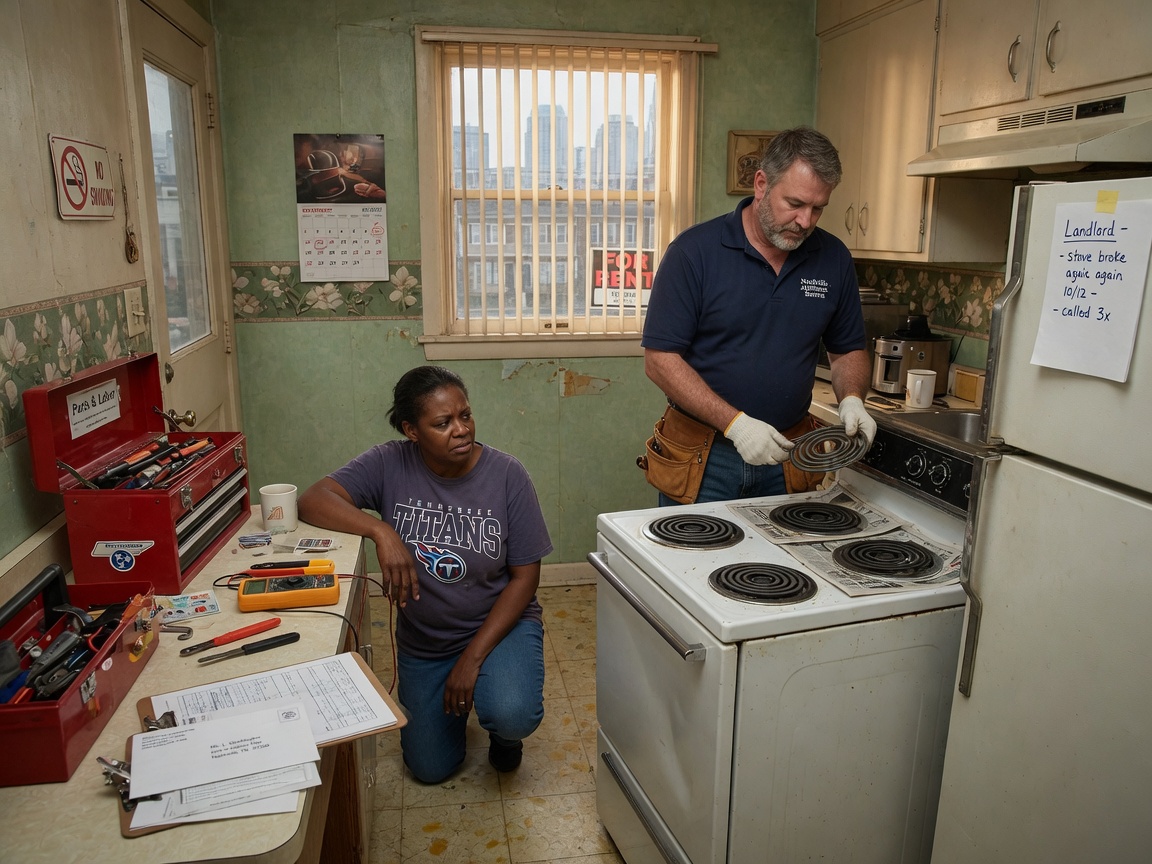
Who pays to fix a broken appliance in a rental depends mostly on the lease. When the landlord supplied the fridge, stove, washer or dishwasher, the landlord usually arranges and pays for the repair. When the tenant caused the damage through misuse, or brought the appliance into the home, the tenant usually pays, and the lease is where both of those rules are normally written down.
That is the short answer on whether a landlord is responsible for appliance repair in Tennessee. The longer answer turns on three things: what the lease says, how the appliance failed, and whether anyone put the problem in writing. Below, tenants and landlords each get their own plain set of steps.
Does Tennessee law make the landlord fix appliances?
Not by name. Tennessee's Uniform Residential Landlord and Tenant Act (URLTA) puts a general duty on the landlord to keep the home fit and habitable, and it does not separately list appliances in that maintenance duty. So whether a landlord must fix a given fridge or washer usually comes down to the lease plus that general duty.
URLTA is Tennessee Code Annotated Title 66, Chapter 28, and the [Tennessee General Assembly](https://www.capitol.tn.gov/) website is the official place to start when you want to read state law yourself. Four pieces of the act matter for a broken appliance:
- Where it applies: Under § 66-28-102(a), the act covers only counties with a population above 75,000 in the 2010 federal census. Davidson, Williamson, Rutherford, Sumner and Wilson counties all clear that bar by a wide margin.
- The landlord's duty: § 66-28-304(a)(2) says the landlord must "make all repairs and do whatever is necessary to put and keep the premises in a fit and habitable condition."
- The tenant's duty: § 66-28-401(4) says the tenant must "not deliberately or negligently destroy, deface, damage, impair or remove any part of the premises."
- Notice: § 66-28-501(a) lets a tenant recover damages and fees for landlord noncompliance "upon giving fourteen (14) days' written notice," and § 66-28-502 requires the tenant to "give written notice to the landlord specifying the breach."
Notice what is missing. The quoted duty talks about the premises, not about a refrigerator, and it states no repair deadline. Nobody can say in advance how far that general language stretches for one particular dishwasher. A fridge that has stopped cooling and is spoiling food is a bigger problem than a broken oven clock, so push at the speed the problem deserves, and read the lease before you push at all.
This is general information, not legal advice. If you are in a dispute, talk to a Tennessee attorney or legal aid.
What should the lease say about appliances?
A good lease says which appliances come with the home and who handles their repairs. If yours is silent, ask. Get the answer in writing before something breaks, because "I thought the landlord handled that" is a poor thing to discover in the middle of a July heat wave with a warm fridge. Five lines are worth finding:
- Appliance list: Which appliances the landlord supplies, such as the refrigerator, range, dishwasher or washer and dryer.
- Who arranges repairs: The landlord, a property manager or a named maintenance contact.
- Who pays: Whether the landlord covers repairs and whether any tenant share is spelled out.
- How to report a problem: Phone, email, text or a portal, and who answers it.
- Tenant-owned appliances: A washer or second fridge you brought yourself is usually yours to fix, because the landlord never supplied it.
A lease line that shifts all appliance repairs onto the tenant deserves a second read. A Tennessee attorney or legal aid can tell you how that line fits with the landlord's duty to keep the home habitable.
When does the tenant pay for an appliance repair?
The tenant can end up paying when the tenant's own misuse caused the failure, since § 66-28-401(4) bars a tenant from negligently damaging the premises. Ordinary wear is a different thing. Repair people see three kinds of failure:
- Wear: A failed evaporator fan motor in a refrigerator, a burned-out bake element or igniter in an oven, a worn dishwasher pump. Parts age out, and nobody did anything wrong.
- Damage: A sock or coin jammed in a washer drain pump, a bone or spoon in a garbage disposal, a door gasket torn off. Someone did something, and the landlord may ask the tenant to cover it.
- Gray area: A dishwasher filter nobody ever cleaned, or a dryer so packed with lint that the thermal fuse blew. Both owners and tenants can see these differently.
We can tell you what failed and what the repair involves. We do not take sides. Who owes what is a conversation for the landlord and the tenant, and it goes best with the written findings in front of both.
How to handle a broken appliance in a rental
Handle it in writing and in order: check the simple causes, report the problem with a date, arrange access, and follow up. Tenants and landlords each have their own sequence.
Tenant steps
Follow these six steps, in this order:
- Check the safe basics. Look at the breaker, the door latch or door switch, the dishwasher filter and the dryer lint trap. Dryer lint is a fire risk, so if a dryer smells hot or burnt, stop using it and say so in your report. If the breaker trips again, water is pooling, or you smell gas, stop and get help.
- Report it in writing the day it breaks. Send a text or email so the date is on record. Give the appliance, the symptom, when it started, and photos or a short video.
- Offer access. Say when you will be home or whether the landlord or a repair person may enter while you are out.
- Protect your food and laundry. Keep fridge and freezer doors shut, and move perishables to a cooler if the repair will take a while.
- Follow up in writing. If nobody answers, send a second dated message. The 14 days' written notice in § 66-28-501(a) and the written breach notice in § 66-28-502 are why a clear paper trail matters.
- Get approval before hiring your own repair person. Ask the landlord to agree in writing first, or you may pay and not be repaid. Before you withhold rent, talk to a Tennessee attorney or legal aid.
Landlord and property manager steps
Landlords and property managers can follow this sequence for any appliance report:
- Acknowledge the report in writing. A short reply that says you received it and what happens next keeps a small problem small.
- Collect the facts. Get the appliance, the symptom, when it started, and the model number label.
- Check the lease and the likely cause. Did you supply the appliance? Does the failure look like wear or like damage?
- Book a diagnosis with access sorted. Confirm that the tenant will be present or has given permission to enter.
- Get the findings in writing before you approve work. You want to know which part failed, what the repair involves, and whether a part must be ordered.
- Decide repair or replace, then close the loop. Tell the tenant what was decided and keep the paperwork with the unit record.
Repair versus replace depends on the part that failed, the age of the appliance, and whether a sealed system or control board is involved. Our repair or replace guide walks through that decision. For managers who handle many units, such as rentals in Antioch and across Davidson and Rutherford counties, one written diagnosis per appliance keeps the owner, the manager and the tenant looking at the same facts. It also keeps the file clean if the question of wear versus damage comes up later. Skip the habit of approving a replacement over the phone before anyone has opened the appliance. A failed bake element or igniter can make a range look dead, and replacing one part is a different job from replacing the range.
What does an appliance repair visit in a rental need?
A rental visit goes smoother when three things are ready: access to the unit, the model number label and a clear description of the symptom. Without them, a technician may need a second trip just to identify the appliance.
- Access: The tenant is home, or the tenant has given permission for a technician to enter.
- Model number label: On a refrigerator it is usually inside the door frame, on a dishwasher along the inside door edge, and on a washer behind the lid or door. A phone photo of it works.
- Symptom description: What the appliance does and does not do, any noise or error code, and when it started. "Fridge warm, freezer fine, fan noise since Tuesday" beats "it's broken."
Spoiled food and wet floors are where waiting costs the most, so a refrigerator repair or washer repair problem in a rental deserves a report the day it happens. That early report matters for any rental appliance repair in Nashville.
We explain what failed and what the repair involves before work starts, in a form a tenant can forward to an owner or property manager. That one document often answers the landlord's first three questions: what broke, whether it was wear, and whether repair makes sense.
Frequently Asked Questions
Is the landlord responsible for appliance repair in Tennessee?
Usually the lease decides, with the landlord's general duty to keep the home fit and habitable behind it. Under § 66-28-304(a)(2), the landlord must "make all repairs and do whatever is necessary" to keep the premises habitable, but the act does not name appliances, so the answer can differ from one fridge, one lease and one county to the next. Check your lease. For a dispute, talk to a Tennessee attorney or legal aid.
Can a landlord make a tenant pay for an appliance the tenant damaged?
Often, if the tenant caused the damage. Section 66-28-401(4) bars a tenant from deliberately or negligently damaging any part of the premises, so a jammed drain pump or a wrecked disposal can land on the tenant. Normal wear is a different matter. A written diagnosis of what failed helps both sides see which one it was.
What should a tenant do if the landlord ignores a broken appliance?
Put the problem in writing with a date. Then follow up in writing. Section 66-28-501(a) refers to 14 days' written notice for a tenant's remedy, and § 66-28-502 calls for notice that specifies the breach, so a vague "the fridge is bad" text is weaker than a dated message that names the appliance and the symptom. Before you withhold rent or pay for the repair yourself, talk to a Tennessee attorney or legal aid.
Does Tennessee's landlord tenant act apply in Nashville?
Yes. Davidson County is far above the 75,000-person line in § 66-28-102(a), and so are Williamson, Rutherford, Sumner and Wilson counties. Smaller counties may fall outside the act, which makes the lease even more important there.
What to do next
Four points cover most rental appliance problems:
- Read the lease first: It usually decides who fixes a supplied appliance.
- Write everything down: One dated text or email on day one, and another if there is no answer.
- Separate wear from damage: A written diagnosis shows which one it was.
- Get findings before approving work: Know what failed and whether a part must be ordered.
If a rental's refrigerator, washer or dishwasher has stopped working and you need a diagnosis the owner can read, [Call (615) 412-2497](tel:6154122497) to book a visit, or see our rental property appliance repair service for landlords and property managers.